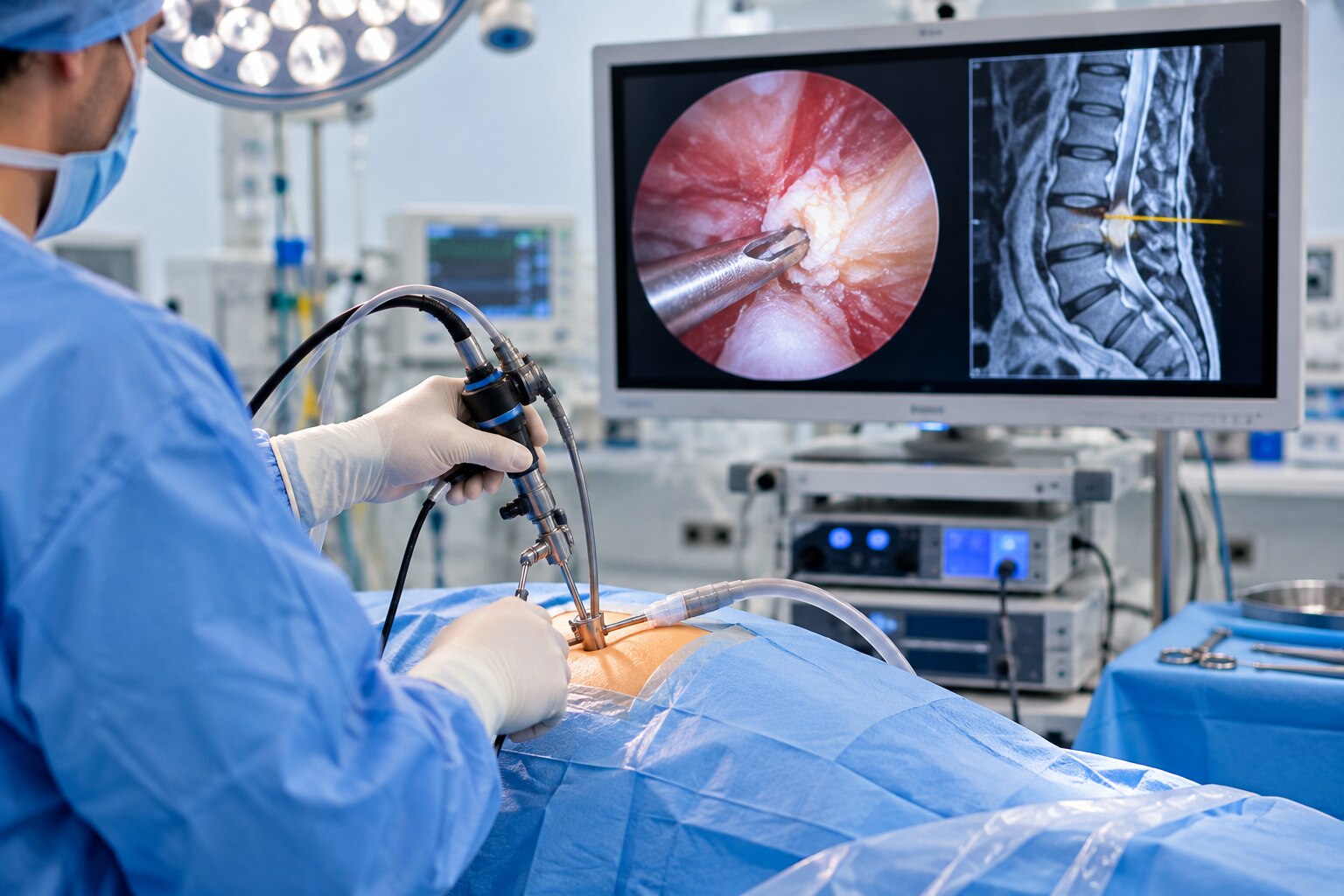
Endoscopic surgery is most useful when a specific disc or narrowed passage is compressing a spinal nerve and causing leg or arm symptoms. By the end, you will know which diagnoses and scan findings support surgery, when another operation or non-surgical care is safer, what the consultation and procedure involve, and how to assess a surgeon before you book.
Key takeaways
- Endoscopic surgery suits nerve compression confirmed by matching symptoms and MRI findings.
- It is the wrong choice for every cause of back or neck pain.
- Ask how the surgeon’s examination, MRI, and symptoms support the proposed operation.
- Confirm the approach, expected recovery, risks, and discharge plan before booking.
Which back and neck conditions can endoscopic surgery treat?
Endoscopic surgery treats selected nerve-compression problems, not every cause of back or neck pain. In the lumbar spine, suitable examples include a contained disc herniation causing sciatica, foraminal stenosis, or lateral recess stenosis when MRI findings match leg pain, numbness or weakness. Selected cervical disc disease causing arm pain or numbness can also qualify.
Many lumbar disc herniations improve with medication, activity modification and physiotherapy. Persistent disabling nerve pain or neurological deficit matters more than the scan label alone. Isolated back or neck pain without a confirmed compressive lesion is a weaker indication because removing disc or bone may not address its source.
- Endoscopic discectomy removes the herniated disc fragment pressing on a nerve.
- Endoscopic decompression enlarges the nerve’s passage by removing obstructing bone or ligament.
- A small incision or muscle-sparing operation is not automatically endoscopic.
| Procedure | What is removed | Main purpose |
|---|---|---|
| Endoscopic discectomy | Herniated disc material | Relieve nerve-root compression |
| Endoscopic decompression | Bone, ligament or other narrowing tissue | Enlarge space around a nerve |
| Other minimally invasive surgery | Depends on the operation | Access the spine with less tissue disruption; no endoscope is implied |
“Laser spine surgery” is not a precise operation name. Ask which tissue will be removed and how the nerve will be decompressed before considering endoscopic back surgery in Jaipur or endoscopic neck surgery in Jaipur. The same questions apply when comparing endoscopic spine surgery in Jaipur.
When is endoscopic surgery the wrong choice?
Endoscopic surgery is the wrong choice when the spine needs stabilisation, reconstruction, or treatment beyond a focal compressed nerve. Removing disc or bone will not correct an unstable spine, major deformity, extensive central-canal narrowing, or a disease such as infection, tumour, or fracture.
Situations that may require another operation or non-surgical treatment include:
- Spinal instability or a case requiring fusion
- Significant deformity or major neck deformity
- Severe cervical spinal-cord compression or myelopathy
- Extensive or multilevel disease
- Infection, tumour, or fracture
- Marked neck pain from disc degeneration without a single compressed nerve
Arm pain travelling into the hand can indicate cervical radiculopathy. Hand clumsiness, balance problems, weakness in several limbs, or bowel and bladder changes suggest spinal-cord involvement and require careful assessment, not a promise that fusion can be avoided.
Seek urgent medical assessment rather than waiting for a routine consultation for urinary retention or incontinence, loss of bowel control, saddle numbness, or rapidly worsening leg weakness. These symptoms can signal cauda equina compression or another emergency.
Smoking, diabetes, obesity, and blood-thinning medicines affect planning, anaesthesia, infection risk, and healing. Tell an endoscopic spine surgeon in Jaipur about every medicine and condition; never stop anticoagulants or antiplatelet drugs without instructions from the prescribing clinician and surgical team.
How do symptoms, examination and scans determine eligibility?
Eligibility depends on one match: your symptoms and examination must point to a specific compressed nerve, and imaging must show the same problem at the same level and side. A scan alone cannot predict whether endoscopic spine surgery in Jaipur will improve you.
1. Describe the symptom pattern and timeline. Tell the surgeon about pain travelling below the buttock into the leg, arm pain extending into the hand, numbness, weakness, altered walking, symptom duration and triggers. Bring your medication list and records showing your response to medication, physiotherapy or injections.
Before you book endoscopic spine consultation, record any change in bladder or bowel control.
2. Expect a neurological examination of muscle strength, skin sensation, reflexes and gait. The surgeon should also check for spinal-cord involvement, including hand clumsiness, balance loss, weakness in several limbs and abnormal reflexes. These findings can indicate cervical myelopathy rather than an isolated pinched nerve.
3. MRI is usually the key test for discs, nerve roots, the spinal cord, foraminal stenosis and central canal narrowing. CT adds detail about bone overgrowth, fracture or complex anatomy. Bring the actual MRI or CT images, not only the radiology report; an incidental disc bulge does not prove it causes pain.
Assessment also checks instability. Standing or flexion-extension X-rays may be appropriate when the examination suggests abnormal movement. The surgeon should discuss non-surgical treatment first and state whether the expected benefit concerns leg or arm pain, numbness, weakness, or mechanical back and neck pain.
Which lumbar approach and operation might be used?
The lumbar approach depends on the disc’s level, location, migration, spinal anatomy and the surgeon’s access route. The two common corridors are:
| Approach | Route | Typical purpose |
|---|---|---|
| Transforaminal | Through the neural foramen from the side | Reaches a disc fragment or nerve root |
| Interlaminar | Between adjacent laminae from the back | Reaches a disc or nerve through the posterior opening |
Neither route is automatically better. The surgeon selects the safer working corridor for your MRI findings, symptoms and anatomy.
Endoscopic discectomy removes the offending disc fragment pressing on a nerve. Endoscopic decompression removes bone, ligament or other tissue narrowing the nerve passage. For endoscopic back surgery in Jaipur, ask which tissue will be removed and how the surgeon will confirm that the nerve is free; “laser spine surgery” is not a precise operation name.
A conventional microscopic discectomy or another minimally invasive operation may be safer when the endoscopic view is inadequate, compression is extensive, or spinal stabilisation is required.
A smaller access route can reduce muscle disruption in selected cases, but it does not eliminate dural tear, cerebrospinal-fluid leak, nerve injury, infection, bleeding, incomplete decompression, recurrent disc herniation, revision surgery or conversion to an open procedure.
Results depend on case selection and surgeon experience, not incision size alone. When comparing an endoscopic spine surgeon in Jaipur, ask how often the proposed approach is converted or revised and which alternative operation would be used if the corridor proves unsafe.
What happens from consultation to discharge, and how do you choose a surgeon?
Expect a staged pathway, not a guaranteed timetable. Before surgery, the consultation should confirm the diagnosis, match your symptoms and examination to the MRI or CT images, and record every medicine and medical condition.
Ask about:
- The planned anaesthesia, consent, alternatives and specific risks
- Expected recovery of pain, numbness or weakness
- Rehabilitation, activity limits and warning signs after discharge
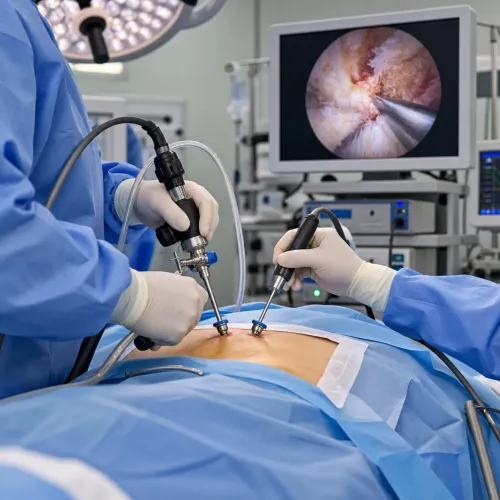
During lumbar surgery, you receive the planned anaesthesia and are positioned to expose the selected level. The surgeon passes instruments through a small access point and working channel to remove disc material or decompress the nerve. The incision is closed, you are observed, and discharge instructions follow the operation, your examination and hospital protocol.
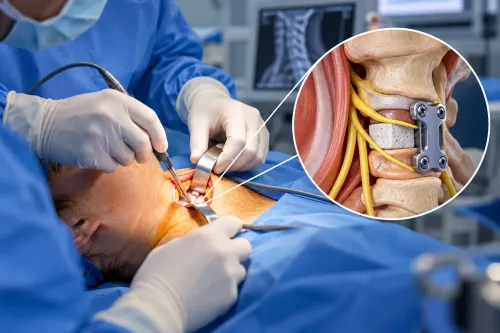
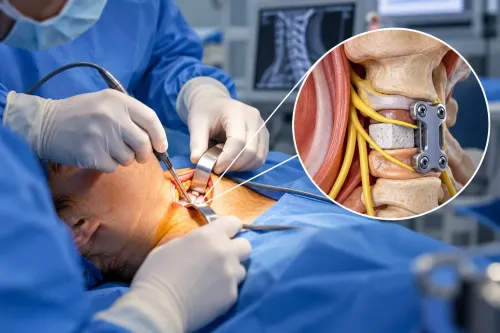
Endoscopic neck surgery in Jaipur requires especially careful approach selection because the cervical spinal cord, nerve roots and nearby vessels leave less room for error.
| Approach | What it reaches | Question to ask |
|---|---|---|
| Posterior foraminotomy | Nerve root from the back | Why does this corridor fit my compression? |
| Anterior decompression | Disc or front-sided compression | Why is an anterior route safer here? |
| Another procedure | Anatomy not suited to either route | Would conventional surgery or fusion be better? |
When comparing an endoscopic spine surgeon in Jaipur, verify formal specialty qualification, hospital privileges, specific endoscopic training, comparable case experience, complication and re-operation rates, and access to conventional or fusion surgery. Dr Rahul Temani can review your actual images, alternatives and rehabilitation plan; bring your scans and medication list before you book endoscopic spine consultation.
Frequently asked questions
Which back and neck conditions can endoscopic spine surgery treat?
It can treat selected nerve-compression problems, including a contained lumbar disc herniation causing sciatica, foraminal stenosis, lateral recess stenosis, and selected cervical disc disease causing arm pain or numbness. MRI findings must match your symptoms.
When is endoscopic spine surgery the wrong choice?
It is the wrong choice when the pain source is not a suitable nerve-compression problem or when symptoms and scan findings do not match. A surgeon must assess the spine’s stability, alignment, degree of narrowing, and the cause of symptoms before recommending it.
How do symptoms, examination, and scans determine eligibility?
Eligibility depends on the pattern of pain, numbness, weakness, reflex and strength findings, and MRI evidence of compression at the same spinal level. A scan alone does not establish that surgery will help.
Which lumbar approach and operation might be used?
The surgeon may choose an endoscopic approach through the back or through the foramen, depending on where the disc or narrowed canal is located. The operation may involve removing a herniated disc fragment or decompressing a nerve.
What happens from consultation to discharge, and how do you choose a surgeon?
The process includes a clinical examination, review of MRI images, discussion of alternatives and risks, procedure planning, postoperative monitoring, and discharge instructions. Ask about the surgeon’s experience with the proposed approach, hospital facilities, complications, follow-up, and expected return to activity.
Keywords