Arm pain, tingling, hand weakness and balance changes can come from pressure on a cervical nerve root or the spinal cord, but an MRI abnormality alone does not prove that surgery is needed. You will be able to identify symptoms that need prompt assessment, understand how surgeons confirm the painful level, and compare ACDF with non-operative care and other cervical procedures.
Key takeaways
- Match MRI findings with your symptoms and neurological examination.
- Ask which cervical level is causing nerve or spinal cord compression.
- Compare ACDF with non-surgical care and motion-preserving alternatives.
- Check a surgeon’s experience with single-level and multilevel cervical procedures.
Which Cervical Problems and Symptoms Fit ACDF?
ACDF surgery in Jaipur may fit a single-level or multilevel cervical disc herniation when the disc compresses a nerve root or the spinal cord. Foraminal stenosis narrows the exit tunnel for a nerve; central canal stenosis narrows the passage containing the cord. The MRI finding matters only when it matches your symptoms and neurological examination.
| Problem | Typical pattern | Symptoms |
|---|---|---|
| Cervical radiculopathy | Nerve-root compression from disc herniation or foraminal stenosis | Arm pain, numbness, tingling or hand weakness on the matching side |
| Cervical myelopathy | Spinal-cord compression from central canal stenosis or a disc-and-bone complex | Hand clumsiness, reduced dexterity, balance trouble, stiff-legged walking or hyperreflexia |
| Neck pain alone | No matching nerve-root or cord compression | ACDF benefit is less predictable; neck pain by itself does not establish a need for fusion |
Nerve-root symptoms usually travel from the neck into the shoulder, arm or hand and follow the affected nerve’s territory. Cord compression affects function below the neck: you may drop objects, struggle with buttons, walk unsteadily or develop new bowel or bladder disturbance.
Worsening weakness, loss of walking ability, or new bladder or bowel symptoms requires urgent assessment, not a routine appointment. A consultation should identify whether the problem is radiculopathy, myelopathy, or pain without a surgically treatable compression.
How Is the Need for ACDF Confirmed Before Surgery?
An MRI report is evidence, not an automatic reason for ACDF. Surgery is justified when the suspected disc or bone compression matches your symptoms, examination findings and functional loss on the same side and at the same cervical level.
1. The clinician checks strength, sensation, reflexes, hand dexterity, walking, balance and signs of spinal-cord compression. Progressive weakness or spinal-cord signs require prompt assessment; you should not wait an arbitrary number of weeks before treatment.
2. The surgeon reviews the actual cervical MRI images, not only the written report, to locate disc herniation, foraminal narrowing or central canal compression. Plain X-rays show alignment and disc-space changes, while flexion-extension X-rays can reveal instability. CT adds detail when bone spurs, calcification or alignment is unclear.
3. Electromyography and nerve-conduction testing can help when several nerve roots, peripheral nerves or diagnoses could explain the symptoms. The result should support a level-and-side match rather than substitute for the clinical examination.
4. The decision records symptom duration, pain severity, work or hand-function loss and treatments already tried. Activity modification, physiotherapy, individually prescribed medication and targeted epidural or selective nerve-root injections may be appropriate before surgery.
Persistent arm pain, numbness or tingling from confirmed nerve-root compression after suitable non-operative care can support ACDF, but worsening weakness or myelopathy should not be delayed for conservative-treatment paperwork.
An acdf consultation in jaipur should therefore end with a specific level, side, neurological reason and treatment rationale—not simply an abnormal scan.
How Does ACDF Compare With Other Treatment Choices?
ACDF fits nerve-root or spinal-cord compression when the affected level, symptoms and examination agree. Anterior cervical discectomy and fusion removes the disc and compressive bone, restores disc-space height with a cage or graft, and fuses the level. It usually offers a stronger rationale for arm pain from radiculopathy than for isolated neck pain.
| Option | What it does | When it may fit |
|---|---|---|
| ACDF | Removes disc and bone compression, restores height and fuses the level | Anterior compression, alignment problems, foraminal or central stenosis, radiculopathy or myelopathy |
| Cervical disc replacement | Removes the disc while aiming to preserve movement | Selected patients with suitable alignment, mobile facets and limited spondylosis |
| Posterior cervical foraminotomy | Enlarges the nerve exit from behind without fusing the level | One-sided nerve compression with favourable alignment and no major instability |
| Cervical laminoplasty | Expands the spinal canal across several levels | Selected extensive cord compression, usually with preserved alignment |
| Non-operative care | Uses activity modification, physiotherapy, medication or targeted injections | Symptoms are improving, compression is limited, or surgery offers no clear advantage |
Motion preservation has a trade-off. Disc replacement may reduce motion loss, but severe facet-joint disease, marked spondylosis or instability can make fusion safer; laminoplasty may address multilevel cord compression without treating every disc directly. For multilevel disease, ACDF treats selected levels but increases fusion length and nonunion risk.
ACDF is a poor fit for neck pain alone without a compressive lesion, symptoms that do not match imaging, severe instability, extensive disease requiring another approach, infection, tumour or fracture.
Do not choose cervical disc surgery in jaipur from an MRI report alone; an anterior cervical discectomy and fusion in jaipur should follow matching symptoms, examination and imaging.
What Happens During ACDF and What Risks Affect Recovery?
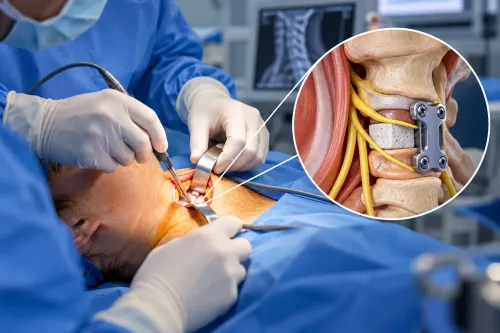
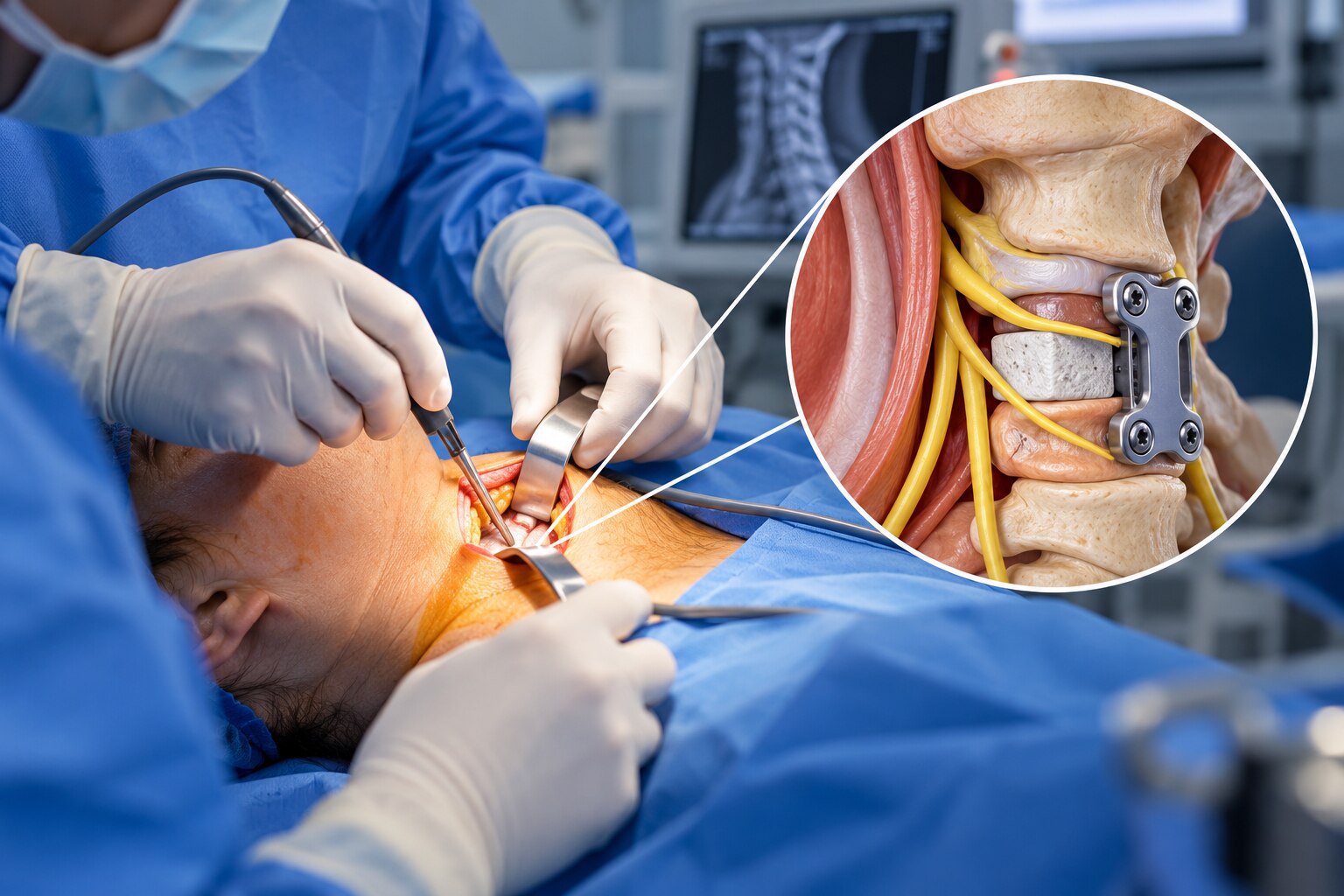
ACDF uses a small incision at the front of the neck. The surgeon moves the swallowing and breathing structures aside, removes the damaged disc and any bone spurs, and frees the compressed nerve root or spinal cord. An interbody cage or bone graft restores disc-space height; a plate and screws add stability when indicated.
ACDF does not put the disc back in place: it removes the compression source and fuses the treated level.
Early recovery often includes throat discomfort, difficulty swallowing and a temporary voice change. A recovery plan for cervical disc surgery in Jaipur cannot promise one timetable because driving, desk work, lifting and exercise depend on neurological status, wound healing, pain control, imaging and the surgeon’s restrictions.
Uncommon but serious complications include:
- A haematoma that causes airway compromise and needs urgent treatment.
- Recurrent laryngeal-nerve injury, causing persistent hoarseness or voice weakness.
- Oesophageal injury, infection or neurological injury.
Pseudarthrosis means the treated vertebrae fail to unite into a solid fusion. The nonunion concern increases with multilevel fusion, and nicotine impairs bone healing; disclose smoking, vaping and nicotine replacement before surgery. Increasing neck swelling, breathing difficulty, severe swallowing trouble or new weakness after discharge requires emergency assessment.
How Should You Compare an ACDF Surgeon in Jaipur?
Choose an ACDF surgeon in Jaipur by testing the reasoning behind the operation, not by relying on a “best surgeon” label. Ask:
- Which exact cervical level and side are proposed?
- Which examination finding supports that level?
- How many levels need treatment?
- Why is ACDF preferred over disc replacement or posterior surgery?
- What happens if symptoms persist, the implant fails, or the fusion does not unite?
| Option | What it does | When it fits |
|---|---|---|
| ACDF | Removes the disc and fuses the level | Matching nerve or cord compression, especially with alignment or instability concerns |
| Disc replacement | Removes the disc while preserving motion | Selected patients without severe facet disease or instability |
| Posterior surgery | Relieves compression from behind | Suitable one-sided foraminal compression or selected multilevel cord compression |
| Non-operative care | Continues monitored treatment without surgery | Symptoms and examination do not justify an operation |
Your consultation should review the MRI images, not only the report, alongside prior treatment, medication risks, nicotine use, diabetes, bone health and functional goals. An ACDF consultation in Jaipur with Dr Rahul Temani can focus on diagnosis, alternatives, surgical risks and recovery planning without assuming every MRI finding requires surgery.
After surgery, seek urgent assessment for increasing neck swelling, breathing difficulty, severe swallowing trouble, new weakness, loss of walking ability, or bladder and bowel changes.
Related service
ACDF (Anterior Cervical Discectomy and Fusion): Modern Neck Spine Surgery ACDF (Anterior Cervical Discectomy and Fusion): Modern Neck Spine Surgery ACDF Surgery (Anterior Cervical Discectomy and Fusion) Anterior Cervical Discectomy and Fusion, commonly known as ACDF, is a highly effective spinal... View service → |
Frequently asked questions
Which cervical problems and symptoms fit ACDF?
ACDF may fit a cervical disc herniation, foraminal stenosis, or central canal stenosis when compression matches symptoms and examination findings. Symptoms can include arm pain, numbness, weakness, clumsy hands, balance changes, or other signs of spinal cord involvement.
How is the need for ACDF confirmed before surgery?
Confirmation combines your symptom history, neurological examination, and cervical imaging such as MRI. The scan must show compression that explains your symptoms rather than an unrelated age-related finding.
How does ACDF compare with other treatment choices?
Your comparison should include non-surgical care, continued observation when appropriate, and other surgical options such as cervical disc replacement. The right choice depends on the compression pattern, affected levels, stability, symptoms, and examination.
What happens during ACDF and what risks affect recovery?
ACDF removes the problematic disc through an anterior neck approach, decompresses the nerve or spinal cord, and places a device or graft to support fusion. Discuss swallowing or voice changes, infection, nerve injury, non-union, adjacent-level problems, and recovery restrictions with your surgeon.
How should you compare an ACDF surgeon in Jaipur?
Ask about the surgeon’s training, experience with your affected cervical levels, recommended alternatives, expected recovery, complication management, hospital facilities, and the details of your ACDF consultation in Jaipur.
Keywords