The strongest candidates are not people with an abnormal MRI alone, but those whose walking-limited leg symptoms, numbness or weakness match proven nerve compression and persist despite an appropriate non-surgical programme. You will learn how to recognise that pattern, understand the diagnostic work-up, distinguish lumbar from cervical stenosis, and compare the operation and its risks before choosing care in Jaipur.
Key takeaways
- Walking-related leg pain relieved by sitting fits spinal stenosis.
- Laminectomy helps when compressed nerves match your symptoms and scan findings.
- Cervical and lumbar decompression treat different patterns of nerve compression.
- Compare surgeon experience, diagnosis, recovery guidance and follow-up before choosing care.
The symptom pattern that points to spinal stenosis
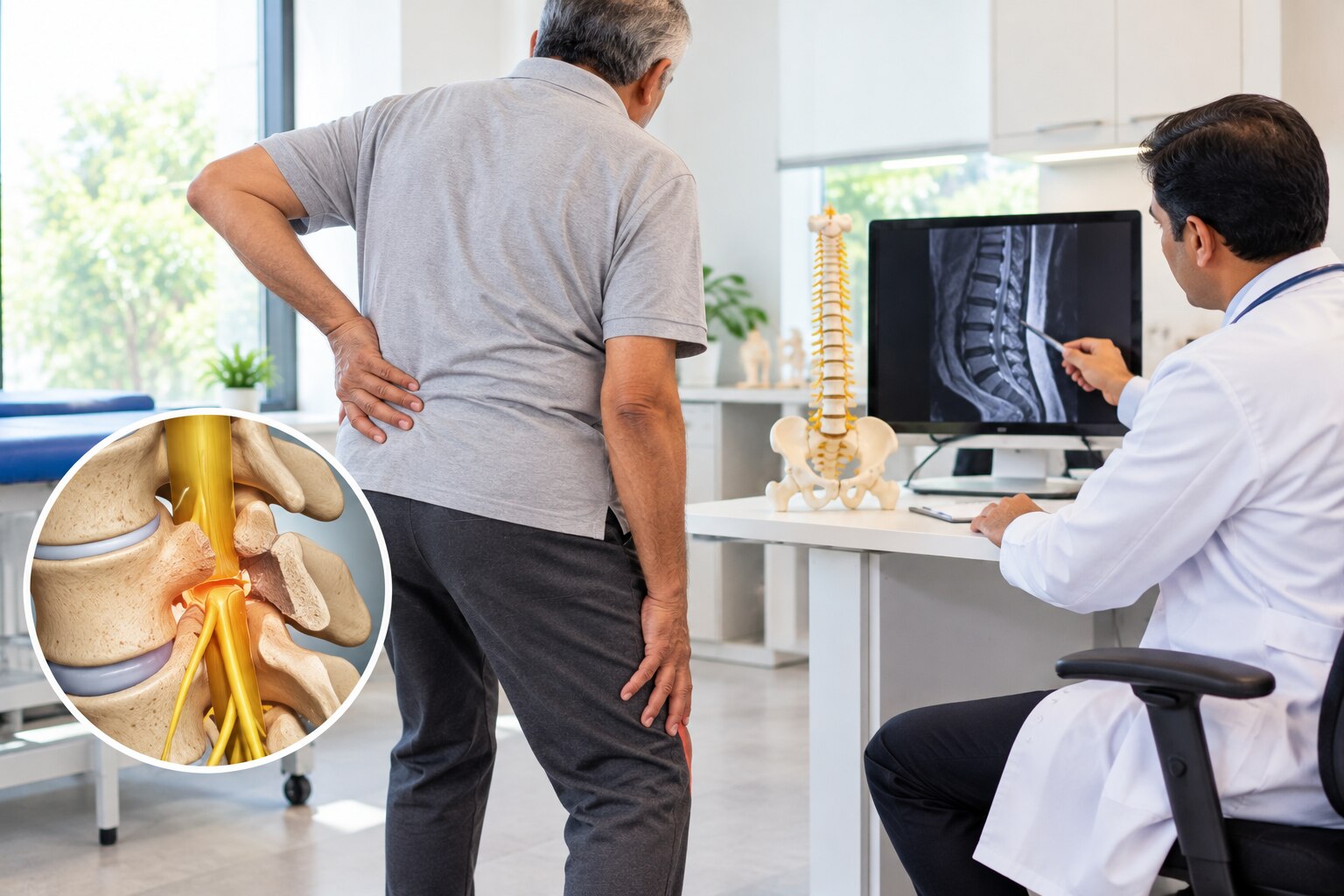
Pain or heaviness in your buttocks and legs during standing or walking points more toward spinal stenosis than ordinary mechanical back pain. Neurogenic claudication can cause aching, tingling, numbness or weakness that eases when you sit or bend forward.
Track the pattern for several days:
- How far you walk before symptoms begin
- How long you can stand before needing to sit
- Whether a shopping trolley or forward-leaning posture lets you walk farther
- Whether symptoms return after rest, and how quickly
Leg-dominant symptoms and reduced walking tolerance make laminectomy benefits more predictable than isolated low-back pain. Laminectomy for spinal stenosis relieves pressure on nerve roots; it does not necessarily correct disc degeneration, facet-joint pain or muscle-related back pain.
Other conditions can produce a similar pattern. Hip arthritis often causes groin pain and difficulty with hip movement. Peripheral neuropathy can cause persistent, usually symmetrical numbness or burning in the feet, including while resting. Vascular claudication causes leg pain with exertion that improves after stopping, regardless of whether you sit or lean forward.
An examination and imaging must match the symptoms before surgery is considered.
Who benefits from lumbar versus cervical decompression
The affected level changes both the symptoms and the urgency. Lumbar stenosis usually compresses nerve roots, causing buttock and leg pain, numbness, heaviness or weakness during walking. Cervical stenosis can compress the spinal cord, causing hand clumsiness, reduced grip, arm symptoms, gait imbalance, falls, and stiffness or weakness in the legs.
| Level | Typical pattern | Surgical relevance |
|---|---|---|
| Lumbar | Buttock or leg pain, numbness, heaviness or weakness with walking | Laminectomy benefits are most predictable when walking is limited by matching nerve compression |
| Cervical | Clumsy hands, weak grip, arm symptoms, imbalance, falls, stiff or weak legs | Cord compression needs prompt assessment because neurological decline can become difficult to reverse |
New bladder or bowel dysfunction, saddle-area numbness, rapidly worsening weakness, or severe bilateral neurological symptoms require urgent assessment, not routine elective planning. These signs can indicate serious cauda equina or spinal-cord compromise.
Age alone does not exclude benefit from laminectomy for spinal stenosis, including in older adults. Safety and recovery depend more on the whole patient: frailty, diabetes, heart or lung disease, anticoagulants, cognitive vulnerability and available rehabilitation support all affect preparation and outcome.
A person with leg-dominant symptoms that match examination and imaging is a stronger candidate than someone whose pain comes mainly from hip arthritis, neuropathy or vascular disease.
How doctors confirm that surgery matches your symptoms
Surgery matches your symptoms when leg-dominant pain, numbness, weakness or walking limitation fits both the neurological examination and the scan. During examination, the doctor checks muscle strength, sensation, reflexes, gait and balance, then maps whether symptoms follow a particular nerve root or suggest spinal-cord compression.
1. The MRI must show canal or foraminal narrowing at the level that fits your symptoms and examination. An MRI report showing stenosis alone is not an indication: spinal narrowing is common in people without pain, and laminectomy for spinal stenosis will not treat hip arthritis, peripheral neuropathy, vascular claudication or nonspecific back pain.
2. Laminectomy removes part of the lamina, enlarging space for a compressed nerve root or the spinal cord. This can improve nerve-related leg symptoms and walking tolerance, but it does not repair disc degeneration, facet-joint disease or every source of back pain. Benefits are less predictable for isolated mechanical low-back pain.
3. If instability or degenerative spondylolisthesis is suspected, flexion-extension X-rays show whether one vertebra moves abnormally when you bend forward and backward. The planned amount of facet-joint removal also matters.
Fusion is not automatic in laminectomy surgery in Jaipur: when there is no instability, deformity or other clear indication, decompression alone avoids extra blood loss, operative time, implants and recovery burden.
When non-surgical care has not worked enough
Surgery becomes reasonable when spinal stenosis continues to restrict your life despite an appropriate non-surgical programme; there is no universal number of weeks. The decision depends on functional loss, neurological findings, symptom duration, symptom severity and your response to treatment.
That programme may include:
- Prescribed physiotherapy to improve strength, flexibility and walking tolerance
- Activity modification, such as reducing prolonged standing while maintaining safe movement
- Suitable analgesic medication chosen around your other conditions and medicines
- A selected epidural or selective nerve-root injection when targeted pain relief could help
An injection can provide temporary relief, but it does not permanently enlarge the spinal canal. Progressive weakness, persistent nerve pain, numbness, or walking limitation that prevents work, household tasks or basic mobility is a reason to revisit surgery rather than repeat ineffective treatment.
Laminectomy benefits are usually more predictable for walking-limited leg symptoms and nerve pain than for isolated mechanical low-back pain. In urgent situations, new bladder or bowel dysfunction, saddle-area numbness or rapidly worsening weakness needs immediate assessment.
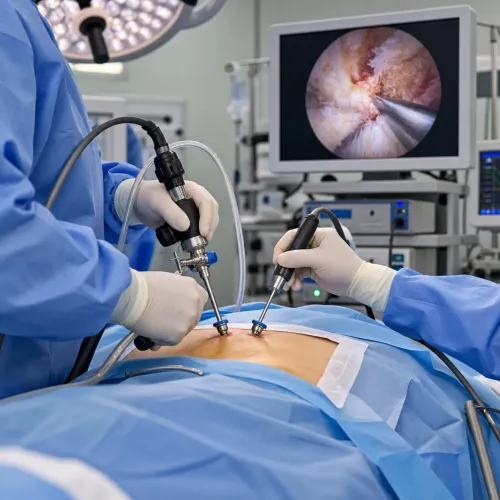
For laminectomy surgery in Jaipur, ask whether a minimally invasive or tubular approach is suitable. It may reduce muscle disruption in selected cases, but the number of levels, anatomy, deformity, surgeon expertise and need for fusion matter more than the technique label. Adequate decompression is the priority.
How to compare nerve compression surgery in Jaipur
A good comparison of nerve compression surgery in Jaipur starts with the match between your symptoms and the scan, not the hospital’s procedure count. Ask for the exact symptomatic level and why decompressing it should improve your leg symptoms.
| Procedure | What it removes or changes | Question to ask |
|---|---|---|
| Laminectomy | Part or all of the lamina | Why is this level causing my symptoms? |
| Laminotomy | A smaller opening in the lamina | Is limited decompression enough? |
| Discectomy | Herniated disc material | Is the disc compressing the nerve? |
| Fusion | Stabilisation of an unstable segment | What instability makes fusion necessary? |
Before consenting, ask:
- What finding during surgery would change the plan, such as instability, a hidden disc fragment or inadequate nerve decompression?
- What are your own rates of dural tear and cerebrospinal-fluid leak, infection, neurological deterioration, readmission and reoperation?
- How will emergency review, physiotherapy and rehabilitation be handled in Jaipur?
Discuss bleeding, blood clots, anaesthetic complications, nerve injury, infection, recurrent or adjacent-level stenosis and further surgery. Pain and walking tolerance often improve before long-standing numbness or weakness; severe or prolonged weakness may not fully recover.
A consultation with Dr Rahul Temani can match your examination, symptoms and imaging to a specific operation instead of treating an MRI report alone. Who benefits from laminectomy in Jaipur is determined by that correlation.
Related service
Laminectomy Surgery for Spinal Stenosis & Nerve Compression Laminectomy Surgery for Spinal Stenosis & Nerve Compression Laminectomy Surgery for Spinal Nerve Compression & Pain Relief Laminectomy is a common spinal surgery performed to relieve pressure on the spinal... View service → |
Frequently asked questions
What symptom pattern points to spinal stenosis?
Pain, heaviness, tingling, numbness or weakness in the buttocks and legs during standing or walking points toward neurogenic claudication, especially when sitting or bending forward brings relief.
Who benefits from lumbar versus cervical decompression?
Lumbar decompression is considered for nerve compression causing leg symptoms or walking limits. Cervical decompression is considered when neck-level compression affects the arms, hands, balance or spinal cord function.
How do doctors confirm that laminectomy matches your symptoms?
They compare your symptom pattern and neurological examination with MRI findings. Surgery is a stronger match when the scan shows compression at the level that explains your symptoms.
When has non-surgical care not worked enough?
Doctors may discuss surgery when supervised exercise, activity changes, medicines or injections have not restored useful walking or daily function, or when weakness or spinal cord signs require prompt assessment.
How should you compare nerve compression surgery in Jaipur?
Compare the diagnosis, proposed level and procedure, surgeon’s relevant experience, hospital facilities, expected recovery, risks, follow-up plan and the available non-surgical alternatives.
Keywords