The right choice depends first on whether the fracture is stable, not on whether an operation appears more definitive. By comparing imaging findings, neurological signs, daily treatment burdens, recovery milestones and surgical risks, you can prepare for a focused treatment discussion rather than choose by reputation or fear.
Key takeaways
- Choose bracing only when alignment and spinal stability remain acceptable.
- Use CT, MRI and neurological findings to assess fracture risk.
- Compare brace care, surgery risks and follow-up before deciding.
- Ask about recovery timelines for fixation, bracing and cement procedures.
When is bracing reasonable, and when does fixation offer a meaningful advantage?
Bracing is reasonable for a stable compression fracture and selected neurologically intact burst fractures when alignment is acceptable, the posterior ligamentous complex is intact, collapse is not progressing, and reliable follow-up imaging is available. A TLSO brace can control movement while the fracture heals, but it requires scheduled X-rays or CT to detect deformity early.
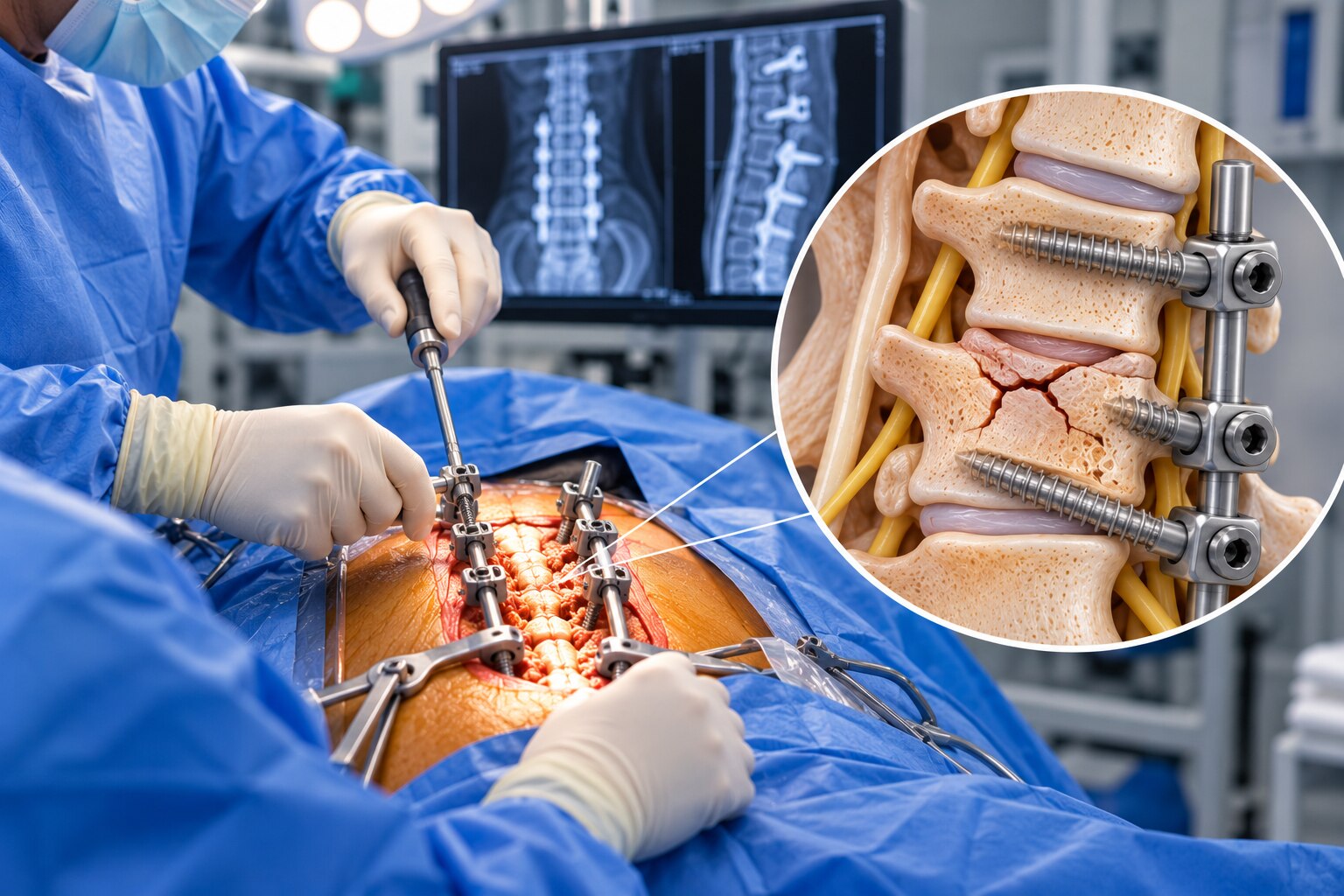
Fixation becomes more relevant for fracture-dislocations, translation injuries, unstable burst or tension-band injuries, marked or worsening kyphosis, posterior-element or posterior ligamentous-complex disruption, canal compromise with neurological deficit, open injury, progressive collapse, or failure of a monitored brace plan.
Fixation can preserve alignment and allow earlier sitting, standing and rehabilitation, but it does not guarantee pain elimination or nerve recovery.
| Option | Alignment and mobility | Surveillance and duration |
|---|---|---|
| Bracing | Avoids operative risks; mobility increases as pain permits, but collapse can restrict activity | Repeat imaging is essential; brace use and activity limits continue until healing is secure |
| Fixation | Better maintains alignment in an unstable pattern and can support earlier rehabilitation | Still needs imaging and wound review; recovery, fusion and strengthening can extend for months |
Randomized evidence in selected stable injuries has found comparable pain and functional outcomes with bracing and surgery, so surgery is not automatically superior. The AO Spine thoracolumbar classification helps distinguish compression, tension-band and translation injuries, but it cannot replace examination, CT and MRI review, bone-quality assessment and an individual stability decision.
How CT, MRI and neurological examination determine spinal stability
Mechanical stability is judged from the fracture’s structure, ligament support and neurological findings—not from how dramatic one scan looks. CT defines the vertebral body, posterior wall, pedicles, transverse and spinous processes, fracture lines, alignment and spinal-canal compromise. It helps classify compression, burst, tension-band and translation injuries under the AO Spine system.
MRI adds the spinal cord, nerve roots, discs, bone marrow and posterior ligamentous complex. It becomes especially important when pain, weakness or suspected ligament injury could change treatment.
A striking CT does not prove that fixation will improve neurological recovery; surgery can restore alignment or prevent collapse, but it cannot guarantee recovery from an established nerve injury.
Urgency rises with leg weakness, numbness, saddle numbness, loss of bladder or bowel control, inability to stand, worsening gait or increasing deformity. An open spinal injury also requires immediate hospital assessment, not routine clinic booking. Do not wait for a scheduled review if these signs appear.
At consultation, ask:
- What is the AO fracture type?
- Is the posterior ligamentous complex intact?
- Is the spinal canal narrowed, and are the cord or nerve roots compressed?
- Is alignment worsening on repeat imaging?
- What is the chance that bracing will fail?
- When is the next neurological examination and scan?
These answers determine whether monitored bracing remains reasonable or whether spinal stability surgery in Jaipur deserves consideration.
What wearing a brace involves—and what fixation risks in return
A thoracolumbosacral orthosis (TLSO) is a rigid, patient-fitted brace that supports the chest, abdomen and lower spine. Your treating team sets the wearing schedule; if instructed, put it on before getting out of bed. It can restrict bending and walking, but it cannot prevent collapse if the fracture is unstable.
- Check the skin after removing the TLSO. Persistent redness, blistering or pressure pain needs prompt review.
- Arrange bathing exactly as instructed; do not stand or walk without the brace if that is prohibited.
- Keep walking within the prescribed limit, using a walker or assistance when advised. Do not add lifting, bending or travel independently.
- Attend repeat standing X-rays, or CT when required, to detect vertebral collapse, worsening kyphosis or alignment change.
Poor adherence can leave pain, deformity or delayed collapse unnoticed. The brace itself can cause discomfort, pressure injury, restricted movement, muscle deconditioning and breathing difficulty, particularly with obesity or lung disease.
Fixation may reduce dissection and blood loss through a minimally invasive approach in suitable patterns, but spine fracture fixation benefits in Jaipur do not remove infection, bleeding, blood clots, anaesthetic complications, nerve or dural injury, spinal cord injury, malpositioned or loosened screws, hardware failure, residual pain, non-union after fusion, adjacent-level fracture or revision surgery.
Stable, improving fractures without neurological compromise can make surgery the wrong choice; instability or neurological compression can make conservative care unsafe.
What recovery looks like after fixation, bracing, vertebroplasty or kyphoplasty
Recovery has two timelines: wound healing and early mobility often improve over several weeks, while fracture consolidation, fusion when performed, strength and confidence can continue improving for months. After fixation, hospital monitoring checks pain, neurological function and mobility; wound care, early walking and physiotherapy begin as advised.
Follow lifting, bending, driving and work restrictions until the treating team confirms safety, with follow-up X-rays or CT.
| Option | Typical recovery focus | Important limitation |
|---|---|---|
| Fixation | Hospital observation, wound care, walking and rehabilitation | Screws and rods may stabilize without fusing every treated level |
| Bracing | Gradual walking, skin checks, prescribed brace use and repeat imaging | Pain, deformity or collapse can progress if the brace is poorly tolerated or follow-up is missed |
| Vertebroplasty or kyphoplasty | Often quicker mobilisation after cement augmentation | Used for selected painful compression fractures, not unstable injuries or neurological compression |
Spinal fracture fixation recovery varies with fracture level and pattern, age, bone quality, neurological injury, smoking, diabetes, fixation length, surgical approach and whether fusion was required. Severe disc or ligament disruption, deformity or poor bone quality can change a stabilisation plan into a fusion plan.
Vertebroplasty injects cement; kyphoplasty first uses a balloon to create a cavity and may restore some height. Neither replaces instrumented fixation for an unstable fracture. Ask for calcium and vitamin D assessment, osteoporosis testing and prescribed bone medication after either strategy; do not self-prescribe supplements.
How to prepare for a Jaipur fracture consultation and compare the total burden
If you are searching for spine fracture surgery in Jaipur, start by taking the complete record to a spine consultation. Bring the CT and MRI discs, written reports, hospital discharge papers, medication list, prior X-rays, comorbidity records, and neurological examination details. Ask whether additional imaging is needed.
Ask these questions at Dr Rahul Temani’s consultation or with another qualified spine specialist:
- Which vertebral levels will be instrumented?
- Is fusion planned, or will screws and rods stabilise the fracture without fusion?
- What happens if I choose a brace?
- When will repeat X-rays or CT check for collapse or worsening alignment?
- What activity, lifting, driving and travel restrictions apply?
- How will I access emergency care if weakness, numbness or pain worsens?
- What physiotherapy and rehabilitation support is available?
Spinal stability surgery in Jaipur describes a consultation and treatment process, not one operation. Compare the total burden, not only the quoted procedure:
| Option | Hospital, recovery and care burden | Costs and logistics |
|---|---|---|
| Bracing | Brace duration, skin checks, physiotherapy, caregiver help, transport and repeated imaging | Follow-up visits, brace and rehabilitation charges, time away from work |
| Fixation | Hospital stay, wound care, early mobility, physiotherapy, caregiver time and travel restrictions | Implants, hospital and rehabilitation charges, follow-up visits and total out-of-pocket cost |
Request a written estimate without assuming a price. Seek a second opinion when time permits; go directly to hospital care for new weakness, saddle numbness, bladder or bowel loss, inability to stand, worsening deformity or an open injury.
Stable, improving fractures may favour monitored non-operative care; instability, neurological compromise or progressive deformity may justify fixation after discussing benefits and risks.
Related services
Spine Fracture Fixation Surgery For Spinal Stability Spine Fracture Fixation Surgery For Spinal Stability & Pain Relief Spine Fracture Fixation is an advanced surgical procedure performed to stabilize broken or collapsed vertebrae, restore spinal... View service → |
Vertebroplasty Treatment Vertebroplasty is an advanced, minimally invasive spine procedure designed to treat painful compression fractures of the vertebrae. View service → |
Frequently asked questions
When is bracing reasonable for a spinal fracture?
Bracing is reasonable for a stable compression fracture and selected neurologically intact burst fractures when alignment is acceptable, the posterior ligamentous complex is intact, collapse is not progressing, and follow-up imaging is reliable.
How do CT, MRI and examination determine spinal stability?
CT shows fracture lines, vertebral collapse, canal narrowing and alignment. MRI assesses the spinal cord, nerve roots, discs and posterior ligamentous complex. A neurological examination checks strength, sensation, reflexes and bladder or bowel changes.
What are the main trade-offs between a brace and fixation?
A TLSO brace limits spinal movement without an operation but requires correct fitting, daily compliance and scheduled X-rays or CT. Fixation offers internal stability and earlier mobilisation in selected unstable fractures, but involves anaesthesia, infection, bleeding, implant failure and adjacent-level risks.
How does recovery differ after fixation, bracing, vertebroplasty or kyphoplasty?
Fixation recovery includes wound care, mobilisation and rehabilitation. Bracing requires weeks of consistent wear and repeat imaging. Vertebroplasty and kyphoplasty can relieve pain from selected compression fractures, but they do not replace fixation when the spine is mechanically unstable.
What should you take to a Jaipur spine fracture consultation?
Take CT, MRI and X-ray images with reports, a medication list, details of the injury, previous conditions, osteoporosis history and changes in strength, sensation, walking, bladder or bowel control.
Related service
Kyphoplasty Treatment for Spine Fractures in Jaipur Kyphoplasty Treatment for Spine Fractures in Jaipur Kyphoplasty is an advanced, minimally invasive spine procedure used to treat vertebral compression fractures (VCFs) caused by osteoporosis, trauma,... View service → |
Keywords