Adults with scoliosis or kyphosis are not choosing between two interchangeable ways to straighten the spine. A brace usually supports comfort, posture or recovery, while surgery addresses selected structural, neurological or balance problems at a higher physical cost. By comparing symptoms, imaging, flexibility, bone health and medical fitness, you can identify which discussion belongs next: a supervised brace trial, broader non-operative care or a surgical opinion.
Key takeaways
- Bracing supports movement but rarely permanently straightens a mature adult spine.
- Try a brace first when symptoms are manageable and the deformity is flexible.
- Compare standing X-rays, spinal balance, nerve symptoms, and the underlying cause.
- Consider surgery when pain, imbalance, weakness, or progression persists despite treatment.
What can a brace change in an adult spine, and what can surgery change?
An adult brace and an operation are not equivalent correction methods. A brace can limit painful movement, support posture and assist rehabilitation, but it rarely permanently straightens a structurally mature spine.
The question behind “spinal deformity surgery or bracing which is better for adults in jaipur” depends on symptoms, function, curve type and bone health—not the X-ray alone.
| Option | What it can change | Main limitation or cost |
|---|---|---|
| Brace | Painful motion, posture and rehabilitation support | Rarely removes a fixed adult curve |
| Non-operative care | Pain and function through physiotherapy, activity changes, appropriate analgesics or anti-inflammatory medicines, osteoporosis treatment and selected image-guided injections | Does not usually remove structural scoliosis or kyphosis |
| Surgery | Decompresses nerves, stabilises collapsed segments and corrects selected structural imbalance | Hospitalisation, months of recovery, infection, non-union, implant failure and adjacent-segment stress |
Scoliosis, kyphosis and mixed deformity require different assessments: a flexible curve may respond to support, while a fixed curve or vertebral collapse will not. Spinal deformity bracing versus surgery becomes a surgical discussion when disabling pain, weakness, nerve compression, progressive imbalance or collapse persists; an attractive X-ray without disabling symptoms is not an indication.
Judge success by walking, standing, sleep, medication use and daily activity, not the Cobb angle alone.
When is adult deformity bracing a reasonable first trial?
A supervised brace trial is reasonable when the curve remains flexible, pain is manageable, neurological function is stable and balance is not severely impaired. You also need to follow a wearing schedule, skin checks, physiotherapy and review appointments.
| Option | Main purpose | When it applies |
|---|---|---|
| Adult scoliosis or kyphosis brace | Limits painful movement, supports posture and assists rehabilitation | Flexible deformity with manageable symptoms |
| Thoracolumbosacral brace for fracture | Protects a healing vertebral injury and reduces painful motion | Recent osteoporotic compression fracture |
| Surgery | Decompresses nerves, stabilises segments or corrects structural imbalance | Progressive, fixed or disabling deformity, or failed non-operative care |
Fracture bracing protects a healing injury; it is not interchangeable with long-term deformity management. A properly fitted adult deformity brace aims mainly at symptom control or postural support, not growth-guided correction. It rarely permanently straightens a structurally mature spine.
Ask for written instructions covering hours of wear, movement limits, breathing comfort, skin inspection, physiotherapy and the review date. Continuous wear without rehabilitation can cause heat, pressure injury, restricted movement, poor adherence and trunk-muscle deconditioning.
A spinal curvature treatment comparison should measure walking, standing, sleep and medication use, not just X-ray appearance. Spinal deformity bracing versus surgery becomes the wrong comparison when the brace is being used instead of diagnosis.
Do not arrange routine fitting for new weakness, bowel or bladder loss, saddle numbness, fever with spinal pain, severe unremitting pain or rapidly worsening deformity. These findings require urgent assessment.
Which measurements and causes determine the adult treatment choice?
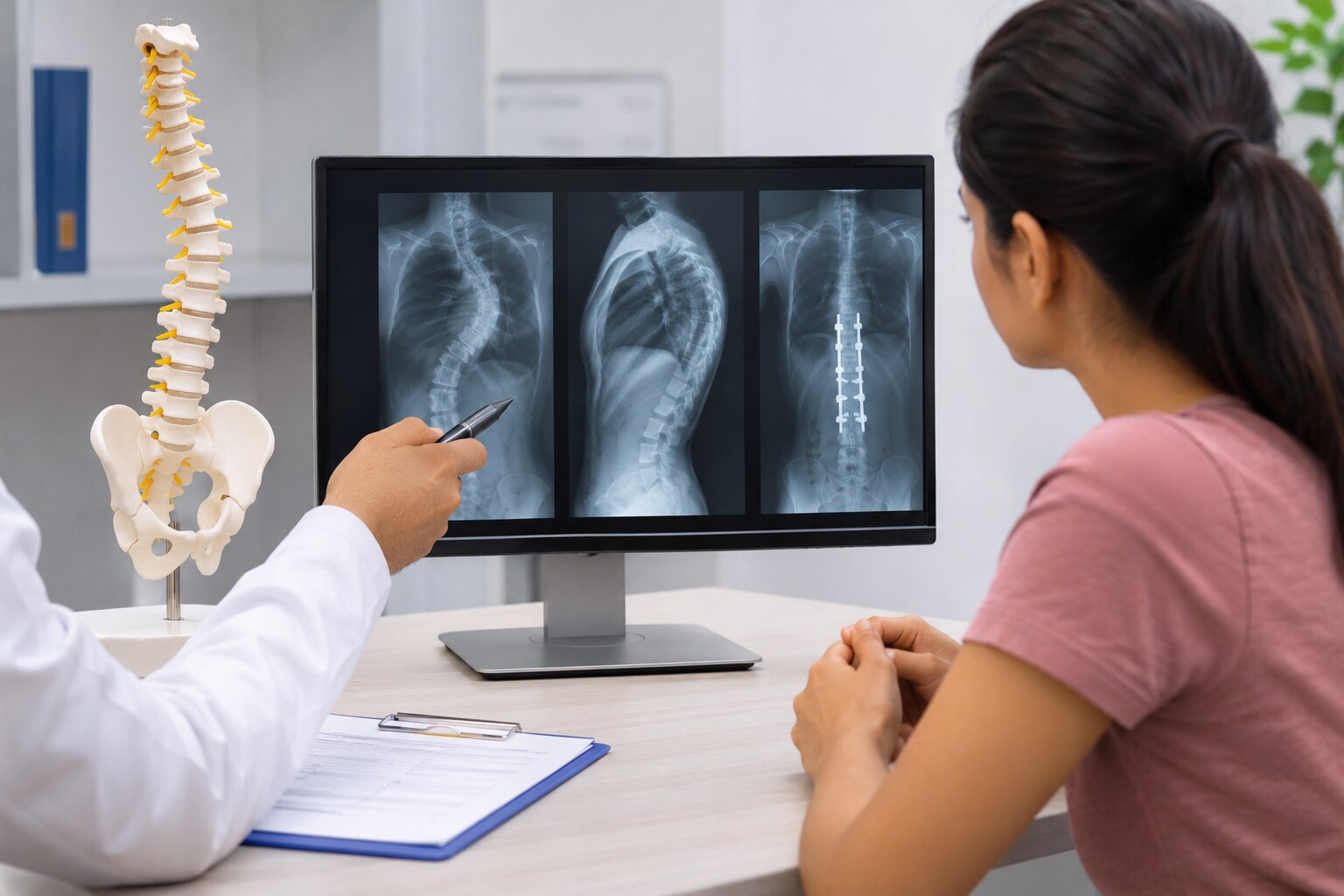
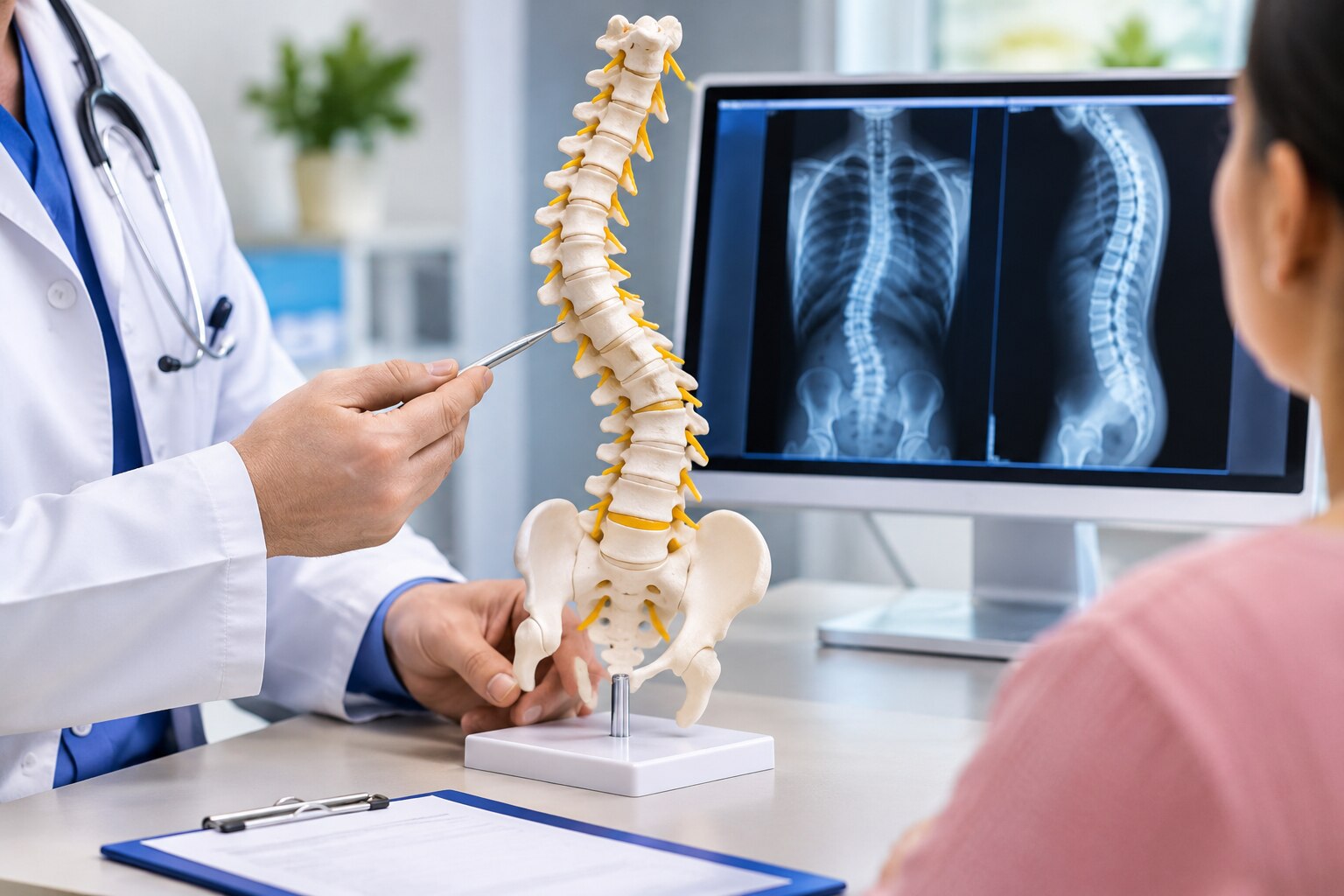
The choice starts with standing full-length spine X-rays, not a Cobb angle alone. Supine or short-segment images can hide global imbalance. Add side-bending or flexion-extension views when flexibility is uncertain; MRI shows discs, stenosis and neural compression, while CT defines bony anatomy and assesses a previous fusion.
| Check | What it shows | Why it matters |
|---|---|---|
| Cobb angle and thoracic kyphosis angle | Curve size and kyphosis | Describes deformity, but does not automatically mandate surgery |
| Sagittal vertical axis and coronal balance | Forward or sideways trunk shift | Identifies global imbalance |
| Pelvic incidence, pelvic tilt and pelvic incidence–lumbar lordosis mismatch | Pelvic compensation and alignment | Helps plan correction |
| MRI and CT | Nerves, discs, bone, fusion and selected disease | Explains symptoms and surgical complexity |
Doctors distinguish structural scoliosis from a pain-related or degenerative curve caused by asymmetric disc wear, facet arthritis, vertebral collapse or osteoporosis. Congenital, neuromuscular, post-traumatic, inflammatory, infectious and tumour-related causes alter treatment, so spinal curvature treatment comparison must include the cause, symptoms, balance, nerve findings and bone quality.
Kyphosis treatment options in Jaipur depend on whether the curve is flexible and postural, fixed and degenerative, fracture-related or linked to another disease. Fever, unexplained weight loss, night pain or sudden painful kyphosis needs diagnosis before bracing. These findings guide adult scoliosis treatment in Jaipur, but no single measurement decides between a brace and surgery.
When does bracing become insufficient, and what does surgery involve?
Bracing becomes insufficient when the deformity or its consequences keep progressing despite a properly fitted brace and rehabilitation plan. A surgical consultation is warranted for:
- Progressive curvature, fixed deformity, major sagittal or coronal imbalance, or vertebral collapse
- Persistent nerve compression, leg weakness, or loss of hand function
- Severe disabling pain or respiratory restriction
- Failure to improve walking, standing, sleep, or daily activity with non-operative care
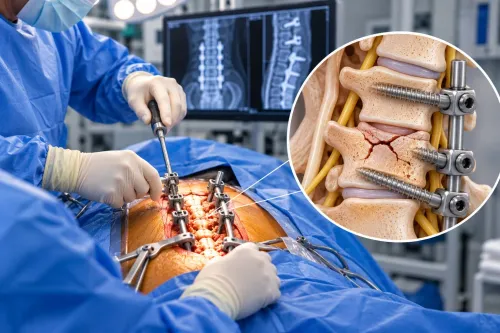
The operation must match the problem. Decompression alone removes pressure around a nerve and may relieve leg pain, but it can worsen instability or imbalance when the deformity drives the symptoms. Limited fusion stabilises selected painful or unstable levels.
Long-segment correction uses instrumentation and, when necessary, osteotomies to realign multiple vertebrae; it offers broader correction but brings greater blood loss, longer recovery, adjacent-segment stress, junctional fracture, and mechanical-failure risk.
Less-invasive techniques reduce muscle disruption or blood loss in selected patients, not the fundamental risks of major correction. The required correction, number of levels, bone quality, frailty, and surgeon experience matter more than the label “minimally invasive.”
Age, frailty, smoking, diabetes, obesity, previous operations, medical fitness, and bone density change the risk calculation. Treat osteoporosis and vitamin-D deficiency before reconstruction when indicated: both increase screw loosening, pseudarthrosis, and implant failure. A brace cannot replace bone-health treatment.
This is why “spinal deformity surgery or bracing which is better for adults in Jaipur” and adult scoliosis treatment in Jaipur require an individual assessment, not a Cobb-angle decision alone.
How should an adult in Jaipur make a safe, practical decision?
Once symptoms and imaging are reviewed, choose the option that addresses your main limitation, not the most dramatic X-ray. A spinal curvature treatment comparison should weigh function, curve flexibility, progression, nerve findings, bone quality and medical fitness—not the Cobb angle alone.
1. Define the problem in measurable terms: how far you walk, how long you stand, whether pain disrupts sleep, whether balance is worsening and how often you need medication.
2. Bring standing full-spine X-rays, including the side view, and every prior operation report, implant record and scan. Ask whether the curve is flexible and whether pain comes from the curve, a collapsed vertebra, stenosis or another cause.
3. Check bone density, vitamin D, diabetes, heart and lung fitness, smoking status and other conditions that affect bracing, healing or anaesthesia. Kyphosis treatment options in Jaipur differ for flexible posture, fixed degeneration, fracture and infection.
4. If pain is manageable and there is no progressive weakness or severe balance failure, agree on a time-limited brace or rehabilitation trial. Set targets for walking, sleep, balance and medication use, then fix a review date.
5. Ask what delay could change, the expected recovery time, and the risks of revision surgery. Arrange imaging and follow-up around work and family duties; plan post-operative transport, home help and rehabilitation monitoring. Dr Rahul Temani can help connect these findings to an individual plan rather than treating bracing or surgery as automatic.
Seek urgent review for progressive weakness, bowel or bladder loss, saddle numbness, fever with spinal pain or rapidly worsening deformity.
Related services
Advanced Spinal Deformity Correction Surgery In Jaipur Advanced Spinal Deformity Correction Surgery In Jaipur Spinal Deformity Correction Surgery Spinal Deformity Correction is a specialized surgical approach designed to treat abnormal curvatures and... View service → |
Kyphosis, Scoliosis & Occipito-Cervical Fusion Surgery Kyphosis, Scoliosis & Occipito-Cervical Fusion Surgery Spinal deformities such as kyphosis and scoliosis can significantly affect posture, balance, mobility, and overall quality of life. View service → |
Frequently asked questions
Can a brace permanently correct spinal deformity in an adult?
Usually not. An adult brace can limit painful movement, support posture, and assist rehabilitation, but it rarely permanently changes a structurally mature spine.
When is bracing a reasonable first treatment for adult spinal deformity?
Bracing is a reasonable first trial when pain is manageable, there is no progressive nerve problem, and the deformity is flexible enough for external support to improve function.
Which measurements help determine whether an adult needs bracing or surgery?
Standing full-spine X-rays, spinal balance, curvature size, flexibility films, pelvic alignment, nerve findings, pain severity, and the deformity’s cause guide the decision.
When does bracing become insufficient for adult scoliosis or kyphosis?
Bracing is insufficient when symptoms remain disabling, the deformity progresses, balance worsens, or weakness, numbness, walking difficulty, or bowel and bladder symptoms develop.
What does adult spinal deformity surgery involve?
Surgery may involve decompression of nerves, spinal fusion, deformity correction, or a combination. The exact plan depends on the curve, balance, bone strength, and symptoms.
Keywords