Back pain is common, but not every episode has the same cause or requires the same level of care. Many people improve with activity modification, medication, physiotherapy, and time. Others continue to experience pain because an underlying spinal condition is irritating a nerve, narrowing the space around neural structures, or affecting spinal stability.
Knowing when to consult a spine surgery specialist can help patients understand the cause of persistent symptoms and explore appropriate treatment options without assuming that surgery will automatically be required.
For patients in Jaipur and other parts of Rajasthan, a specialist assessment can be particularly useful when back, neck, or radiating limb pain is beginning to interfere with work, sleep, walking, or everyday activities.
Signs That Deserve a Specialist Assessment
Pain intensity alone does not determine whether a spinal condition is serious. The pattern, duration, neurological symptoms, and effect on daily function are equally important.
A specialist consultation may be appropriate when:
- Back or neck pain continues despite appropriate conservative treatment
- Pain travels from the lower back into the buttock, thigh, calf, or foot
- Neck pain spreads into the shoulder, arm, or hand
- Tingling or numbness persists in an arm or leg
- Weakness develops in the hand, foot, arm, or leg
- Walking or standing becomes increasingly difficult
- Symptoms repeatedly return and affect normal activities
- Imaging has identified a disc, nerve, or structural spinal problem
New bladder or bowel control problems, numbness around the groin or saddle region, rapidly worsening weakness, or major symptoms following significant trauma require urgent medical assessment.
What Does a Spine Surgery Specialist Actually Evaluate?
A spine consultation is not simply a discussion about an operation.
The first objective is to determine whether the symptoms are actually coming from the spine and, if so, which structure is responsible. Similar pain patterns can occasionally arise from muscles, joints, hips, peripheral nerves, or other conditions.
The assessment generally considers the patient's medical history, onset of symptoms, aggravating movements, neurological findings, previous treatments, and available imaging. Strength, sensation, reflexes, posture, movement, and walking may also be examined.
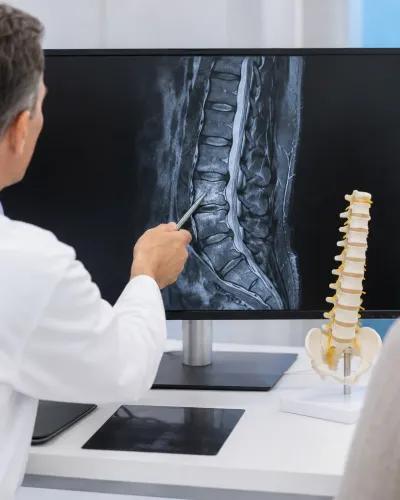
MRI, X-ray, CT, or other investigations may be considered when clinically appropriate. Imaging findings should be interpreted alongside symptoms rather than treated in isolation because some disc or age-related changes can exist without causing pain.
Does Seeing a Spine Surgeon Mean You Need Surgery?
No. A surgical specialist can also determine when an operation is unnecessary.
Depending on the diagnosis, treatment may involve medication, activity modification, physiotherapy, rehabilitation, posture or ergonomic changes, targeted interventions, monitoring, or surgery.
The decision becomes more specific when three questions are answered:
- What structure is causing the symptoms?
- Is there meaningful nerve compression, instability, deformity, infection, or another structural problem?
- Is conservative treatment appropriate and safe for the patient's current condition?
This approach helps avoid treating an MRI report instead of treating the individual.
Why Persistent Nerve Symptoms Matter
Radiating pain, numbness, tingling, or weakness can indicate nerve involvement. For example, a lumbar disc problem may irritate a nerve supplying the leg, while a cervical spine problem can affect nerves travelling into the arm.
Persistent neurological symptoms deserve appropriate evaluation, particularly when weakness is developing. Waiting indefinitely while function deteriorates may not be appropriate for certain conditions.
At the same time, nerve pain does not automatically mean surgery. The cause, severity, duration, examination findings, and response to previous treatment all influence the next step.
Preparing for a Spine Consultation
Patients can make the appointment more useful by bringing previous MRI or X-ray reports, prescriptions, physiotherapy records, and details of earlier procedures.
It also helps to explain:
- When the problem started
- Where the pain travels
- Whether numbness or weakness occurs
- Which activities worsen or relieve symptoms
- How far you can comfortably walk or sit
- What treatments have already been tried
Patients consulting Dr Rahul Temani in Jaipur can use the assessment to understand the likely diagnosis, available non-surgical options, and whether a surgical opinion is relevant to their particular condition.
The purpose of specialist spine care is not to move every patient toward surgery. It is to establish a clear diagnosis, recognise neurological or structural concerns, and choose treatment according to the individual's symptoms and functional needs.
Keywords