Surgery can improve walking, standing, balance and daily function when a spinal curve causes forward imbalance, nerve compression, disabling pain or restricted chest movement. It does not guarantee a normal spine or pain-free movement, so you need to match the proposed operation with the specific limitation, curve pattern and health risks identified during assessment.
Key takeaways
- Surgery can improve standing, walking distance, balance and stair use.
- Consider surgery when pain, nerve compression or imbalance limits daily life.
- Compare alignment goals, neurological risks, recovery demands and surgeon experience.
- Ask how imaging and physical examination support the predicted mobility improvement.
Which movement problems can kyphosis or scoliosis surgery improve?
Surgery can improve walking, standing and daily activities when spinal deformity causes forward imbalance, pain or nerve compression. Kyphosis is excessive forward rounding in the sagittal plane; scoliosis is a sideways curve with vertebral rotation. Correcting either problem can help you stand more upright, look forward, walk farther, climb stairs and maintain balance.
| Movement problem | Possible improvement | Important limitation |
|---|---|---|
| Forward trunk imbalance | Upright standing, forward gaze and better balance | A straighter X-ray does not prove restored mobility |
| Pain or nerve compression | Longer walking distance, easier stairs and improved sitting | Persistent nerve damage can limit recovery |
| Severe thoracic curvature | Better posture and, in selected cases, chest mechanics | Lung restriction can remain irreversible |
| Spinal stiffness | Alignment and function can improve | Fused spinal segments permanently lose normal movement |
The spinal deformity surgery benefits depend on what is restricting you. Fixed hip or knee contractures, neuropathy, arthritis, muscle weakness and poor balance can continue to limit walking after the spine is corrected. Surgery does not guarantee completely normal spinal movement or eliminate every source of pain.
When comparing kyphosis scoliosis surgery benefits in jaipur, focus on the daily change being targeted: standing, walking, sitting, stair use or balance. The practical spinal deformity surgery benefits are usually improved function and tolerance, not a fully flexible spine.
Pulmonary testing deserves attention when a large thoracic curve causes breathlessness or major thoracic fusion is planned.
When is surgery more reasonable than observation, therapy or bracing?
A major operation is more reasonable when the expected improvement in walking, standing, balance or daily activity outweighs the risks of reconstruction. A progressive curve or a fixed imbalance that keeps you from looking forward, walking or using stairs deserves a surgical discussion.
That threshold is stronger when you have:
- Progressive kyphosis or scoliosis despite observation
- Severe forward or sideways trunk imbalance
- Spinal cord or nerve compression causing weakness, numbness or walking difficulty
- Disabling pain despite appropriate physiotherapy and pain management
- Breathing compromise from a severe thoracic deformity
- Failure of an appropriate brace when bracing is suitable
For adolescent idiopathic scoliosis, a curve around 45–50 degrees that is still progressing can prompt discussion of scoliosis surgery in Jaipur. The Cobb angle is not a decision by itself: skeletal maturity, curve pattern, balance and symptoms change the recommendation.
For Scheuermann-type kyphosis, 70–75 degrees is a discussion range, not an automatic operation threshold. Progression, pain, neurological findings and functional impairment determine whether kyphosis surgery in Jaipur is reasonable.
Adults need a wider risk assessment because complications and revision surgery can offset mobility gains. Check bone density and address smoking, diabetes, poor nutrition and low fitness before elective reconstruction. If your symptoms are stable and you retain useful function, observation, targeted therapy or pain management may serve you better than surgery.
How do surgeons predict whether mobility will improve?
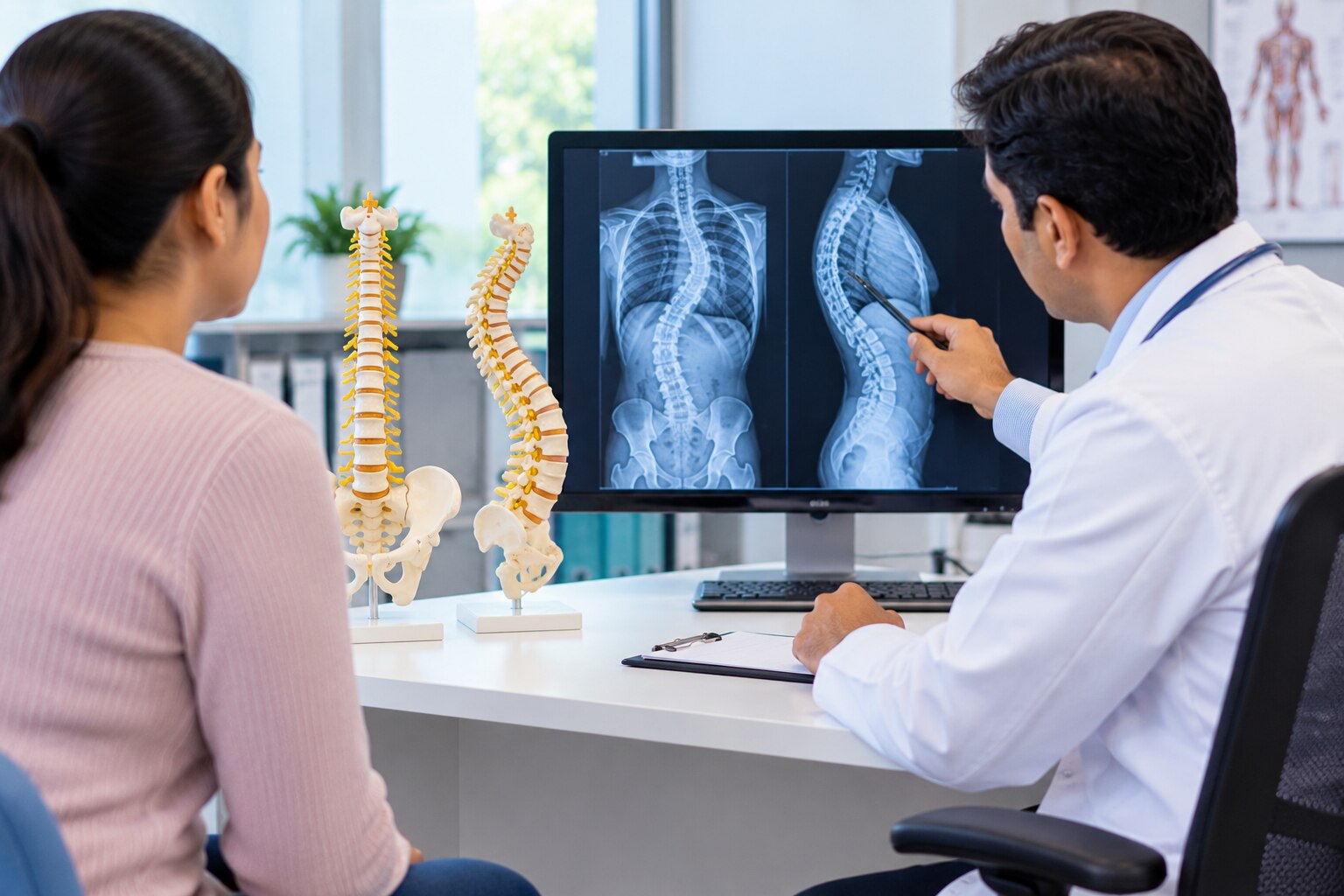
A credible mobility forecast starts with measuring both the deformity and the task it prevents. A straighter X-ray does not guarantee longer walks; surgeons must identify whether alignment, pain, nerve compression or another condition limits you.
1. Take standing full-spine X-rays to measure the Cobb angle, sagittal vertical axis and pelvic parameters showing whether the pelvis is compensating. Add bending films when flexibility affects the surgical plan.
2. Use MRI to examine the spinal cord and nerves, and CT to define bony anatomy. Complete a neurological examination to identify weakness, altered sensation or reflex changes that could affect walking.
3. Record walking distance, standing time, stair difficulty, falls, pain scores and specific task limitations. A validated disability questionnaire creates a baseline for comparison after treatment.
4. Watch your gait and balance directly. These findings help separate movement restricted by spinal alignment from movement restricted by hip disease, knee contracture, neuropathy, arthritis, muscle weakness or deconditioning.
5. Check bone density when osteoporosis or age raises the risk of fixation failure. Add cardiopulmonary assessment for breathlessness, a large thoracic curve or a planned major fusion, because lung restriction can persist despite correction.
This information turns spinal deformity surgery benefits into a realistic prediction: better standing, walking or balance, not guaranteed normal movement. It also shows when rehabilitation or treatment of another condition must accompany spinal surgery.
What does the operation trade for better alignment and function?
A larger correction is not automatically a safer or more useful correction. Two people with similar-looking curves may need different procedures because one has flexible deformity, nerve compression or poor sagittal balance, while the other has a rigid curve, pelvic compensation or healthier alignment elsewhere.
The operation may involve several components:
- Decompression removes bone or ligament that is pressing on the spinal cord or nerves.
- An osteotomy cuts and reshapes part of the spine when a rigid deformity cannot be corrected by positioning alone.
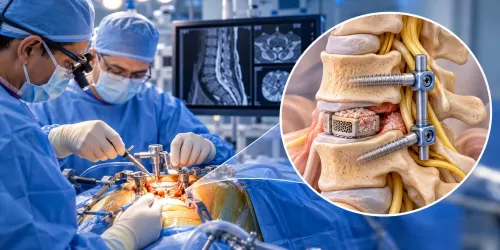
- Instrumentation uses screws, rods or other implants to hold the planned alignment.
- Fusion lets bone grow across the treated levels and maintain the correction after the implants are no longer carrying the entire load.
A staged operation can be safer than one extensive procedure for selected patients with severe deformity, medical risk or a long proposed fusion. Instrumentation holds the correction while bone fusion develops, but fused levels permanently lose flexibility; a longer fusion limits more movement.
Planning therefore considers global sagittal and coronal balance, pelvic alignment and the proposed fusion range—not simply the most curved vertebra. Kyphosis surgery in Jaipur and scoliosis surgery in Jaipur should be judged by the mobility gain expected from that complete plan.
Occipitocervical fusion benefits selected patients with craniovertebral-junction instability, basilar invagination, trauma, tumour, inflammatory destruction, deformity or cord compression by stabilising and protecting the cord and brainstem. It is not routine treatment for ordinary neck pain or uncomplicated scoliosis, and it sacrifices substantial upper-neck rotation and flexion-extension.
What should you compare before choosing spinal deformity care in Jaipur?
A credible comparison for kyphosis surgery in Jaipur or scoliosis surgery in Jaipur starts with evidence, not hospital location. Ask for your standing full-spine radiographs, the documented neurological examination, the proposed fusion levels and one realistic mobility target: walking distance, standing balance, forward gaze, stair use or pain-limited activity.
Use these questions during each consultation:
- Does bone-density testing, lung-function testing or medical-fitness assessment change the plan?
- How will smoking, diabetes, poor nutrition and low conditioning be addressed before surgery?
- What will rehabilitation include, and when will walking, stairs, driving and work become realistic?
- What are the surgeon’s complication and revision rates for comparable deformity operations?
- How are non-union, implant failure and junctional problems monitored and treated?
- What is the immediate plan for new weakness, fever, wound drainage, bladder or bowel changes, or swallowing difficulty?
Compare the proposed choices on the same basis:
| Option | Expected benefit | Main trade-off |
|---|---|---|
| Surgery | Better alignment, balance, gaze or nerve-related walking limits | Permanent loss of movement across fused levels; months for fusion and full function |
| Optimisation and non-operative care | Time to improve fitness, bone health, pain control and conditioning | The curve or neurological problem may continue progressing |
| Second opinion | Checks fusion range, correction target and alternatives | Adds time, but can expose an unnecessarily large operation |
Early walking is encouraged after many operations; it does not mean the fusion is solid. For kyphosis and scoliosis surgery benefits in Jaipur, a consultation with Dr Rahul Temani can connect these measurements and recovery expectations to your curve rather than applying one standard technique.
Related services
Kyphosis, Scoliosis & Occipito-Cervical Fusion Surgery Kyphosis, Scoliosis & Occipito-Cervical Fusion Surgery Spinal deformities such as kyphosis and scoliosis can significantly affect posture, balance, mobility, and overall quality of life. View service → |
Advanced Spinal Deformity Correction Surgery In Jaipur Advanced Spinal Deformity Correction Surgery In Jaipur Spinal Deformity Correction Surgery Spinal Deformity Correction is a specialized surgical approach designed to treat abnormal curvatures and... View service → |
Frequently asked questions
Which movement problems can kyphosis or scoliosis surgery improve?
Surgery can improve forward imbalance, painful standing, walking tolerance, balance, stair climbing and movement limited by nerve compression. Results depend on the deformity, nerve condition and overall health.
When is surgery more reasonable than observation, therapy or bracing?
Surgery becomes more reasonable when deformity progresses, pain remains disabling despite non-surgical care, nerves are compressed, or imbalance prevents normal standing and walking. Observation, therapy or bracing may suit stable deformity without severe symptoms.
How do surgeons predict whether mobility will improve?
Surgeons compare standing full-spine X-rays, CT or MRI findings, neurological examination, walking limitations and the planned correction. They also assess hip and knee position, spinal flexibility, bone strength and medical fitness.
What does spinal deformity surgery trade for better alignment and function?
The trade-off includes a long recovery, postoperative pain, blood loss, infection, nerve injury, implant problems, non-union and possible revision surgery. Larger corrections carry greater surgical demands.
What should you compare before choosing spinal deformity care in Jaipur?
Compare the diagnosis, proposed alignment target, surgical approach, complication plan, rehabilitation pathway, hospital support and follow-up schedule. Ask which symptoms the operation is expected to improve and which may remain.
Keywords